¶ Abstract
Information concerning properties of wood, different species, buying, milling, drying and storing lumber.
¶ Structure
¶ Lignin, cellulose and wood glue:
Watch this short video for a very good explanation of the basic principles:
¶ Different milling cuts
Series of short videos by Plate 11 Woodworking:
- 🎬 https://www.youtube.com/watch?v=83uI7InFpBk - General information
- 🎬 https://www.youtube.com/watch?v=cUfMgaNLWTQ - Flat/Plain sawn
- 🎬 https://www.youtube.com/watch?v=FowmHEavQ_8 - Rift sawn
- 🎬 https://www.youtube.com/watch?v=VW14m9tH7Hk - Quarter sawn
- ongoing
¶ Understanding/Reading the Grain
- short introduction to reading the grain (Popular Woodworking magazine article)
- another understanding grain article (woodmagazine, nice illustration of growth affecting grain)
- illustration of wood grain cutting directions and implications
- 🎬 https://www.youtube.com/watch?v=NZqYh-6c0m8 - Reading the Grain
- 🎬 https://www.youtube.com/watch?v=lVTS9b5bmNE - Wood is like Straws
- 🎬 https://www.youtube.com/watch?v=47OSZ5lgPBM - Understanding Wood Grain
¶ Movement
Wood changes its dimension when gaining or losing moisture. This effect is negligable in the longitudinal axis, pronounced in the tangential plane and a little less in the radial direction.
The most important consideration is to come up with a construction that does not prevent expansion and contraction in the radial or tangential plane through glue, nails or screws. There are time-proven methods of dealing with this. Anything less wide than 2" is usually not critical. Additionally, any boards that don't have the growth rings perpendicular to one face, can cup or bow which also needs to be taken into account. The topic warrants a dedicated article.
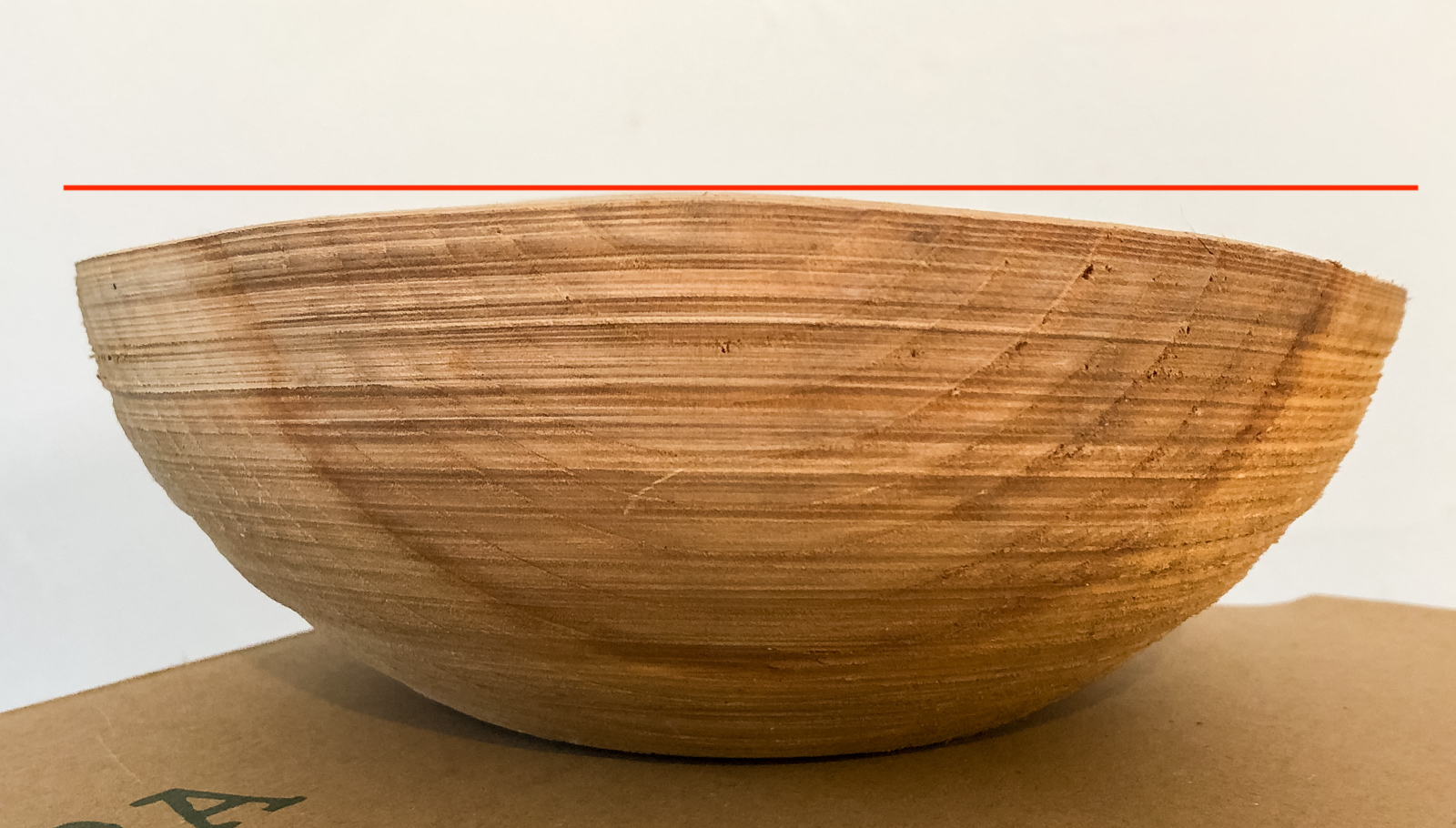
An illustration of how much wood can move: this cherry bowl was turned green and shrunk and warped during drying so the rim curved an the overal shape became oval:
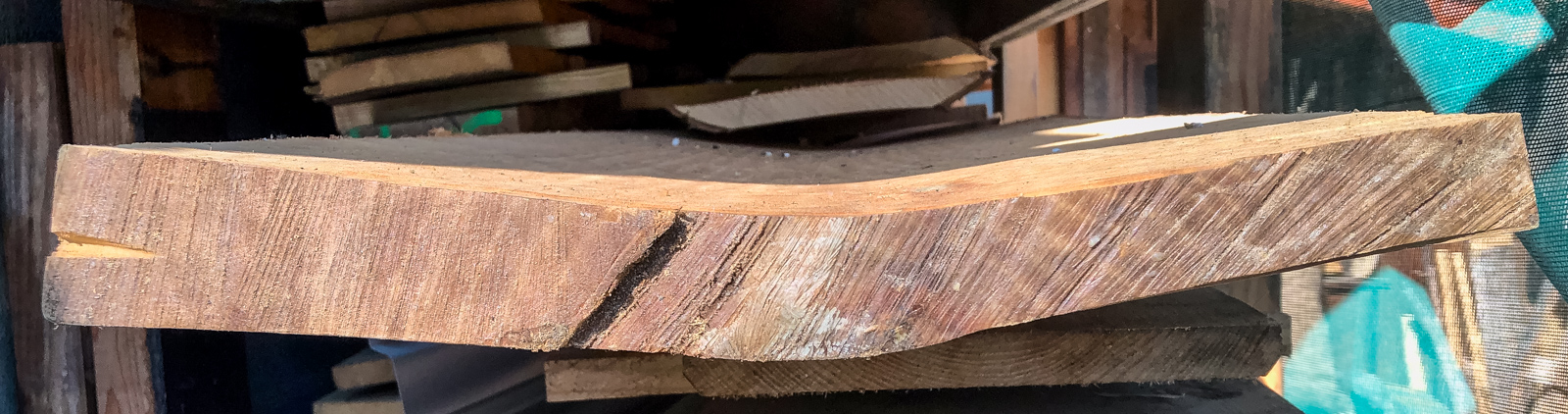
This is a (European) walnut slab that has dried for about half a year.
- 🎬 https://www.youtube.com/watch?v=eF_LlF1VLHM&t=455s - video visualizing wood movement tangentially and radially (timestamped)
- https://soundcloud.com/user-715157026/46-wood-movement-101 - podcast on wood movement (+ Q&A)
- http://www.woodweb.com/Resources/RSCalculators.html - calculators, e.g. for shrinkage, board foot, weight, volume
- http://www.woodbin.com/calcs/sagulator/ - sagulator to estimate shelve sagging behavior
- Lumber Update on Wood Movement and a Q&N
¶ Species and Identification
- https://wood-database.com - species information
- https://woodbarter.com - forum with people good at identification
- http://hobbithouseinc.com/personal/woodpics/ huge collection of sample photos (i.a. end-grain) of different species
- https://insidewood.lib.ncsu.edu/search - many images, mostly microscopy
- https://www.delta-intkey.com/citeswood/en/index.htm - good images for identifcation of some species
- https://www.lib.ncsu.edu/specialcollections/forestry/hough/index.html - Romeyn B. Hough plates of 350 American wood species
- https://trace.tennessee.edu/utk_agexfores/10/ PB1692 Wood Identification for Hardwood and Softwood Species Native to Tennessee - good introduction to wood features and properties in identification
- https://pfaf.org/user/Default.aspx - plant database useful for identification of live specimen
- https://www.baumkunde.de/baumbestimmung/ 🇩🇪 - tree identification
- https://www.baumkunde.de/forum/viewforum.php?f=8 🇩🇪 - tree identification forum
¶ Classification
¶ Nomenclature
There's some confusion about the terminology used sometimes. This chart may help to understand how species can be classified.

- Most lumber species are in the Conifer class and Eudicots clade. Non-coniferous gymsnosperms and Monocots are of secondary importance.
- Magnolia and Liriodendron (tulip poplar) make up all of the Magnoliidaes
- for a definition of semi-deciduous, see →Wikipedia
- Eucalyptus can be semi-deciduous or evergreen, depending on the species →Wikipedia
¶ Tools
¶ Moisture meter
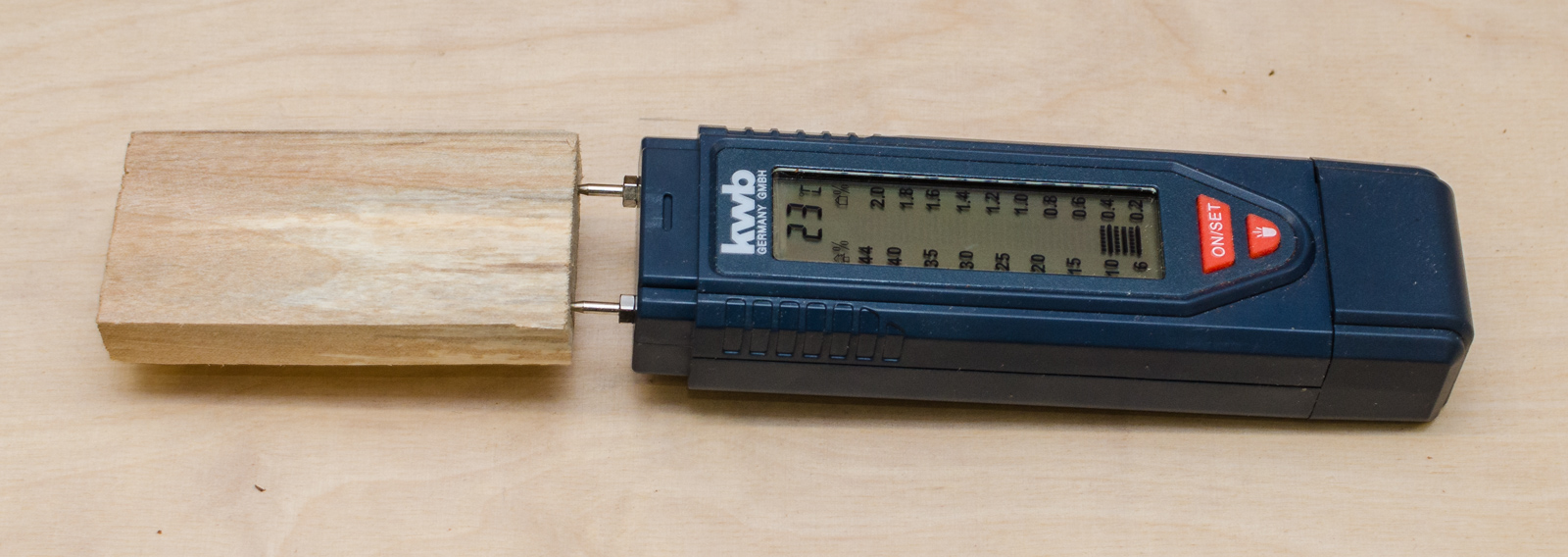
Used to determine the moisture content of a piece of wood.
¶ Wood calipers
Used to measure the diameter of logs.
¶ Resources
¶ Shannon's Lumber Industry Update podcast
- https://www.lumberupdate.com
- https://www.lumberupdate.com/60-softwoods-101/ - Softwoods
- https://www.lumberupdate.com/episode-12-air-dried-vs-kiln-dried-lumber/ - Air vs Kiln dried
¶ General
- https://www.advantagelumber.com/woodglossary/a-terms.html - lumber glossary
- https://www.fpl.fs.fed.us/products/publications/specific_pub.php?posting_id=101316&header_id=p Wood Handbook - Wood as an engineering material: properties, fastening, adhesives, finishing, composites, ...
- https://www.norwoodsawmills.com/articles/stickers-and-blocking-101:-how-to-stack-and-dry-lumber - lumber stickering guide
¶ Properties
- 🎬 The Way Wood Works - good introduction to wood properties and movement
¶ Density/Weight
In addition to consulting the wood-database here are some charts with overviews
- 📄 Wood density chart - in lb/ft3 and kg/m3
- 📄 wood weights - green and airdry, only lb/ft3
- 📄 List of wood densities for tree species from tropical America, Africa, and Asia - by species, for the special cases
¶ Grain Runout
¶ Safety
¶ Wood Cutting Boards
research about comparing wooden and plastic cutting boards with regards to bacteria
https://www.terrygrimmond.com/res/uploads/2015/01/Cliver-UC-Davis-Food-Safety-Laboratory_-Cutting-Board-Research-Overview-2005.pdf(archive: https://web.archive.org/web/20230214161312/https://www.terrygrimmond.com/res/uploads/2015/01/Cliver-UC-Davis-Food-Safety-Laboratory_-Cutting-Board-Research-Overview-2005.pdf)- https://commonsensehome.com/wooden-cutting-boards/ referencing:
- https://pubmed.ncbi.nlm.nih.gov/31113021/ - full article: http://www.treenshop.com/Treenshop/ArticlesPages/SafetyOfCuttingBoards_Article/CliverArticle.pdf
- https://www.researchgate.net/publication/228343502_Survival_of_bacteria_on_wood_and_plastic_particles_Dependence_on_wood_species_and_environmental_conditions
- https://www.finewoodworking.com/2024/10/10/the-best-food-safe-finish-may-be-none-at-all
- https://www.microbehunter.com/wooden-vs-plastic-cutting-boards-which-is-safer-for-food-hygiene/
¶ Food-safe vs food-grade
¶ Books
- Understanding Wood, R. Bruce Hoadley
¶ Resources
- dataholz.eu - materials, components and construction �🇺🇸/🇩🇪
- informationsdienst-holz.de - focus on wood as a building material 🇩🇪